
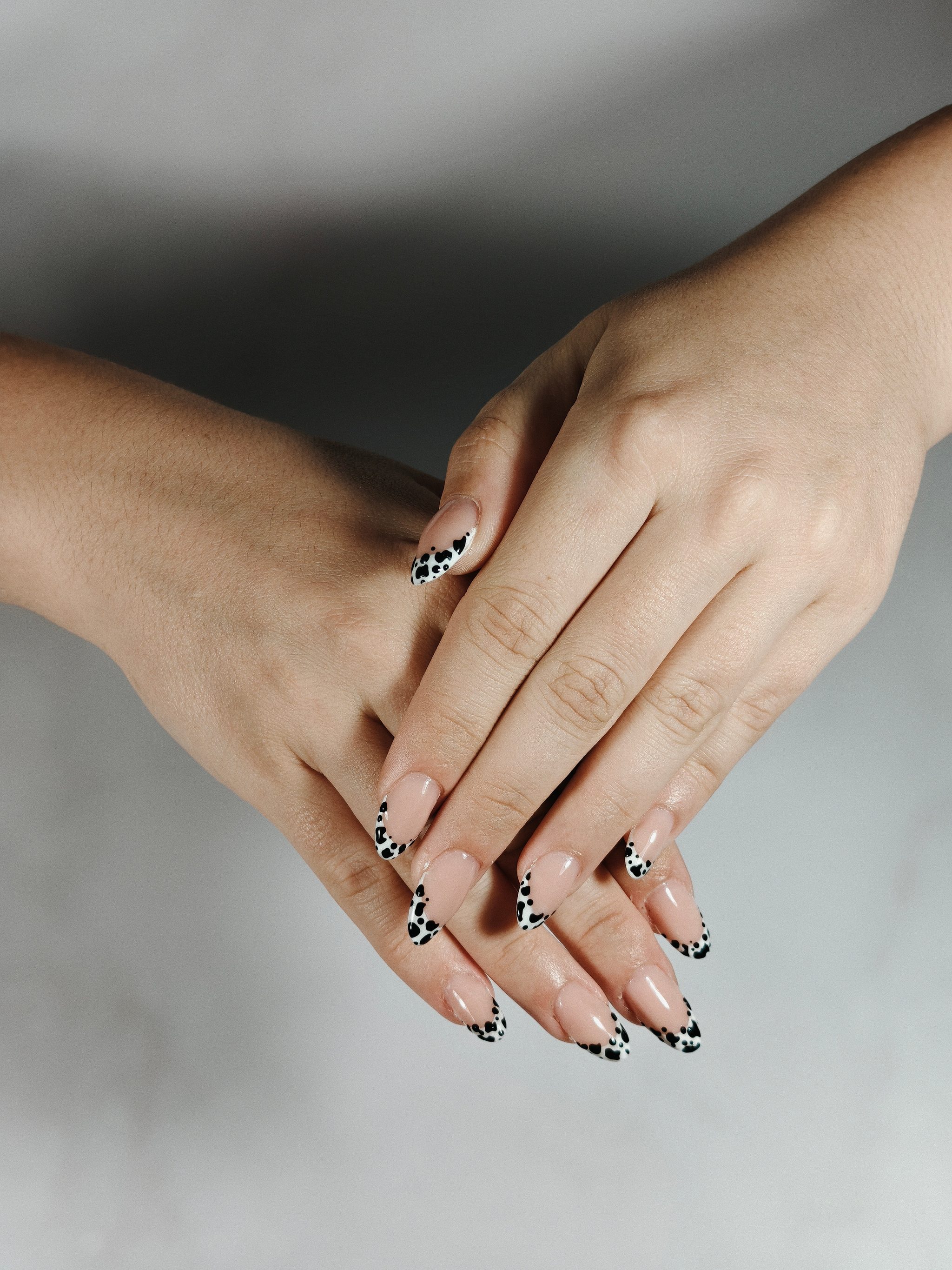
French manikir više nije samo beli: Najlepše moderne varijante frenča
Some manicure trends become popular for a single season, appear everywhere — and then disappear.
And then there is the French manicure.
Lengths, shapes, colors, finishes, and entire aesthetics have changed over the years, yet that thin line at the tip of the nail has somehow always found its way back.
Except that in 2026, we are no longer talking exclusively about a clear or pink base with a white tip.
Today, a French manicure can be burgundy, brown, black, metallic, barely noticeable, double-lined, asymmetrical, decorated with polka dots, or even completely transparent.
Allure has highlighted the modernized French manicure as one of the major nail directions for 2026, including micro-French tips, chrome finishes, different textures, and unexpected color combinations.
In other words:
The French manicure is no longer just one design. It has become an entire category of nail art.
How Did One White Tip Become a Classic?
The classic French manicure as we know it today originated in the 1970s.
According to Allure and Vogue, Jeff Pink, founder of Orly, created the look in 1976 as a practical solution for film sets. Actresses needed a manicure that would not have to be changed every time they switched costumes, so a combination of a neutral nail and a clean white tip was created to work with almost anything.
The style was later given the name “French manicure,” and over the following decades it went through almost every phase a trend can experience — from a symbol of elegance, to the extra-wide white tips of the early 2000s, and eventually back to a much more subtle version.
Its adaptability is probably exactly why it has lasted for so long.
Celebrity nail artist Kim Truong describes it for Vogue as an extremely versatile design that can be adapted to different nail shapes, skin tones, and personal styles.
And today, we have far more options than just a white line.
Micro-French: A Few Millimeters That Change the Entire Manicure
If we imagine the classic French manicure as a clearly defined white line across the tip of the nail, the micro-French is its much more subtle version.
The line is extremely thin — sometimes so delicate that you only notice it when you take a closer look.
That is exactly why it feels clean, elegant, and modern.
Vogue and Allure highlight the micro-French as one of the most important versions of the French manicure in 2026, particularly because it works beautifully on short natural nails as well.
And white is no longer the only option.
The thin line can be:
- burgundy;
- chocolate brown;
- black;
- pastel;
- red;
- gold or silver;
- or a different color on every nail.
That makes the micro-French a great choice when you want something more interesting than a solid-color manicure, but do not want the design to take over the entire nail.
A little color, a lot of impact.
Colored French Tips: The Same Classic, a Completely Different Personality
Probably the easiest way to turn a classic French manicure into something modern is to change just one thing:
the color of the tip.
White becomes burgundy.
Or chocolate brown.
Or olive green.
Or navy blue.
And suddenly, the exact same design looks completely different.
Throughout 2026, colored French tips have appeared across a wide range of seasonal trends. Cosmopolitan, for example, highlights burgundy and other unconventional colors as a modern interpretation of the French manicure for fall, while Byrdie features a wide range of pastel, contrasting, and multicolored versions.
The advantage is that you can keep the base very neutral.
That means the manicure still works easily with different outfits while no longer looking completely traditional.
For fall — wine, espresso, and olive.
For spring — pastel pink, lilac, or blue.
For summer — bright colors.
And if you cannot choose just one?
Each nail can have a different color.
Chrome and Metallic French Tips: When You Want a Little More Shine
If there is one way to make a classic French manicure instantly feel more modern, it is a metallic finish.
Instead of a white line, the tip can be silver, gold, bronze, or chrome.
In 2026, Vogue specifically highlighted metallic and chrome French tips as a contemporary version of the classic manicure, with silver tips among the most noticeable variations.
What makes this style so interesting is the contrast.
A soft, neutral base looks incredibly simple.
And then the light hits the tip.
And the entire manicure changes.
This type of French manicure can be extremely thin and subtle or wider and more dramatic.
That is why it can look both elegant and slightly futuristic — depending on how you wear it.
Double French: When One Line Simply Is Not Enough
A classic French manicure has one line.
A double French has two.
Most often, the second line sits directly below the first, but modern interpretations are much more flexible.
You can combine two colors.
One thin line and one thicker line.
A metallic shade with a matte finish.
Or place one line at the tip and another near the base of the nail.
In September 2026, Byrdie highlighted the double French as one of the modern versions of this classic, featuring combinations of pastel shades, chocolate tones, magnetic effects, geometric details, and different textures.
And this is a perfect example of just how far the French manicure has come from the original white tip.
The basic idea is still the same.
But the rules are much more flexible.
Reverse French: The Same Idea, Just at the Other End of the Nail
What happens when we move the line from the tip of the nail to the bottom?
We get a reverse French manicure.
Instead of following the free edge of the nail, a thin line highlights the area near the cuticle.
Vogue specifically mentions this technique as an interesting variation of the micro-French for short nails — the colored line follows the lower edge of the nail and creates a clean, graphic effect.
It can be extremely subtle.
A thin gold line over a milky base.
A black line on a natural nail.
A burgundy detail over a soft pink base.
You can even combine a classic and reverse French manicure in the same set.
That creates a kind of frame around the nail — without the need for complicated artwork.
French Tips With Polka Dots, Lines, and Tiny Details
Sometimes, you do not need to change the shape of the French tip at all.
You only need to change what appears on it.
Instead of a solid-colored tip, you can add:
- tiny polka dots;
- thin lines;
- stars;
- hearts;
- floral details;
- animal print;
- or a very small illustration.
Betina Goldstein, one of the nail artists who helped popularize the micro-French, points out in Allure that the thin line can easily become a space to experiment with color and small details, including polka dots.
This is an especially good option when you want nail art without covering all ten nails in detailed designs.
Sometimes, three tiny dots are enough.
Glass French: When the Tip Almost Disappears
One of the more unusual variations Allure highlights for 2026 is the glass French manicure.
The idea is simple: the tip of the nail remains transparent, creating a glass-like effect.
The result looks very different from a traditional French manicure.
There is no strong white line.
There is no dramatic contrast.
Instead, the design plays with transparency, shine, and light.
It is a good example of how the modern French manicure is no longer defined solely by color.
Sometimes, all you need to change is the texture.
French Tips With Effects: Cat-Eye, Ombre, and Different Textures
2026 brings another interesting change — the tip does not even have to be a single solid color.
It can have a magnetic “cat-eye” effect.
It can transition from one color into another.
It can shimmer.
It can have a velvet-like finish.
It can be chrome.
Allure identifies the combination of different textures as one of the elements keeping today’s French manicure fresh, while Byrdie showcases magnetic, ombre, and textured finishes in modern double-French designs.
This means the line at the tip is no longer simply the border between two colors.
It becomes a small space for nail art.
Does a French Manicure Have to Be Completely Symmetrical?
There was a time when the goal was a perfect line.
Every nail identical.
Every curve almost exactly the same.
Today, that is no longer the only option.
Nail artist Jin Soon Choi describes the 2026 French manicure for Allure as fresher, more artistic, and less focused on “perfection,” with playful interpretations, tonal combinations, and unexpected textures.
So the line can be:
diagonal,
wavy,
asymmetrical,
double,
or different on every nail.
As long as the set shares a common color palette or style, every nail does not have to be identical for the manicure to feel cohesive.
Sometimes, a small imperfection is exactly what turns a classic design into something more interesting.
Which French Manicure Works Best for Your Nail Length?
One of the biggest advantages of the French manicure is that it can be adapted to almost any nail length.
If you have short natural nails, the micro-French is one of the most flattering options. The very thin line takes up very little space and can visually enhance the shape of the nail. Vogue highlights it as a particularly good option for short nails for exactly this reason.
With medium-length nails, you have more room for a slightly wider tip, color, double French lines, or small details.
With longer nails, you have even more space for ombre tips, different textures, chrome effects, patterns, and more pronounced lines.
But longer nails do not mean the design has to be more complicated.
A very long almond-shaped nail with a thin black line can look far more striking than ten different details.
Length gives you space. It does not mean you have to fill all of it.
What About Nail Shape?
The shape of the nail also changes the way a French manicure looks.
On almond-shaped nails, the line can naturally follow the narrower tip and further emphasize the elongated appearance.
On square nails, a straighter French tip can create a very clean, graphic result.
On oval nails, a softer curved line follows the natural shape.
And on very short nails, a thin micro-line often looks neater than a very wide tip.
There is no single “correct” French manicure for every shape.
It looks best when the line is adapted to the proportions of the individual nail, rather than simply copying the exact same design onto every hand.
Interesting Fact: The French Manicure Did Not Actually Originate in France
If you have ever assumed that the French manicure was created in a Parisian salon — you are not alone.
But the story is quite different.
According to the history shared by Allure and Vogue, Jeff Pink created the design in the United States in 1976 as a practical look for Hollywood film sets. The name “French manicure” came later, after the style was introduced in a fashion environment associated with Paris.
So one of the most famous “French” beauty classics actually began as a solution to a very practical problem:
How do you create nails that work with every costume?
Fifty years later, we have an answer to a completely different question:
How many different things can we do with one line at the tip of a nail?
Apparently — quite a lot.
A Few Tips Before Choosing Your Next French Manicure
If you want something that remains very subtle, choose a milky or soft pink base with a micro-French tip.
If you want a classic with a little more personality, simply change the color of the tip — burgundy, brown, black, or olive can completely transform the look.
If you love shine, try a metallic or chrome tip.
If you want something more creative but still understated, add a second line, a few polka dots, or a small detail on one or two nails.
If you already have a statement design, not every nail needs to be different. Sometimes a few simple nails make the detailed ones look even better.
And most importantly:
Do not choose a French manicure based only on a photo. Adapt it to the length, shape, and proportions of your own nails.
The exact same design can look completely different on a short square nail and a long almond-shaped nail — and that is perfectly fine.
In Short
The French manicure of 2026 is no longer simply a pink base with a white tip.
Micro-French tips feature an extremely thin, minimalist line and work especially well on short nails.
Colored French tips replace white with burgundy, brown, pastel, or bright shades.
Metallic and chrome French tips add shine without making the entire nail metallic.
Double and reverse French manicures change the placement of the lines and give the classic design a completely different geometry.
And polka dots, patterns, magnetic effects, and different textures turn the tip of the nail itself into a space for nail art.
The foundation remains the same.
Everything else can change.
Sources
For an overview of modern French manicure variations and 2026 trends, current expert and editorial selections from Allure were consulted, including The French Manicures of 2026 Are Extra-Celestial and The Biggest Nail Trends of 2026 Upgrade the Classics.
For micro-French manicures, modern interpretations of the French manicure, and adaptations for shorter nails, current 2026 articles from the American, British, and French editions of Vogue were consulted.
For metallic and chrome variations, trend reports from Vogue were used, while contemporary selections from Byrdie were consulted for double, colored, and textured French manicures.
For the history of the classic French manicure, articles from Allure and Vogue marking the design’s 50th anniversary were consulted.